








The phrase fix error unitemforce does not appear to be a standard official error name from a major software vendor. In search results, it shows up mostly on low-quality SEO pages and scattered community discussions, which is usually a sign that people are using it as a label for an unclear or recurring problem rather than a formal error code.
That matters because the right fix depends on where the problem appears. In practice, the issue is often one of these: a broken browser script, an extension conflict, cached data corruption, a buggy app install, or a device-level problem on Android or Windows. Official support pages from Google, Mozilla, and Microsoft all recommend troubleshooting steps that line up with those causes.
Why this error usually happens
When people search for an unknown error like this, the real issue is often not the error text itself but the environment around it. A web page may fail because the browser is holding bad cached data. An app may break because a plugin, add-on, or extension is interfering. A phone may behave strangely because another app is causing the issue in the background.
A Reddit discussion about a launcher script error shows the same pattern: users reported ad blocker interference, launcher layout changes, and file verification as practical fixes. That does not prove the cause of “unitemforce” specifically, but it does show how unknown script-style errors often behave in the real world.
How it works: the best way to troubleshoot it
The most reliable way to fix an unclear error is to move from the outside in. Start with the easiest environment checks, then isolate the app, browser, or device feature that is most likely failing. Official support documentation from Google, Mozilla, and Microsoft follows this same logic: reduce variables first, then test each layer one by one.
Here is the simple pattern:
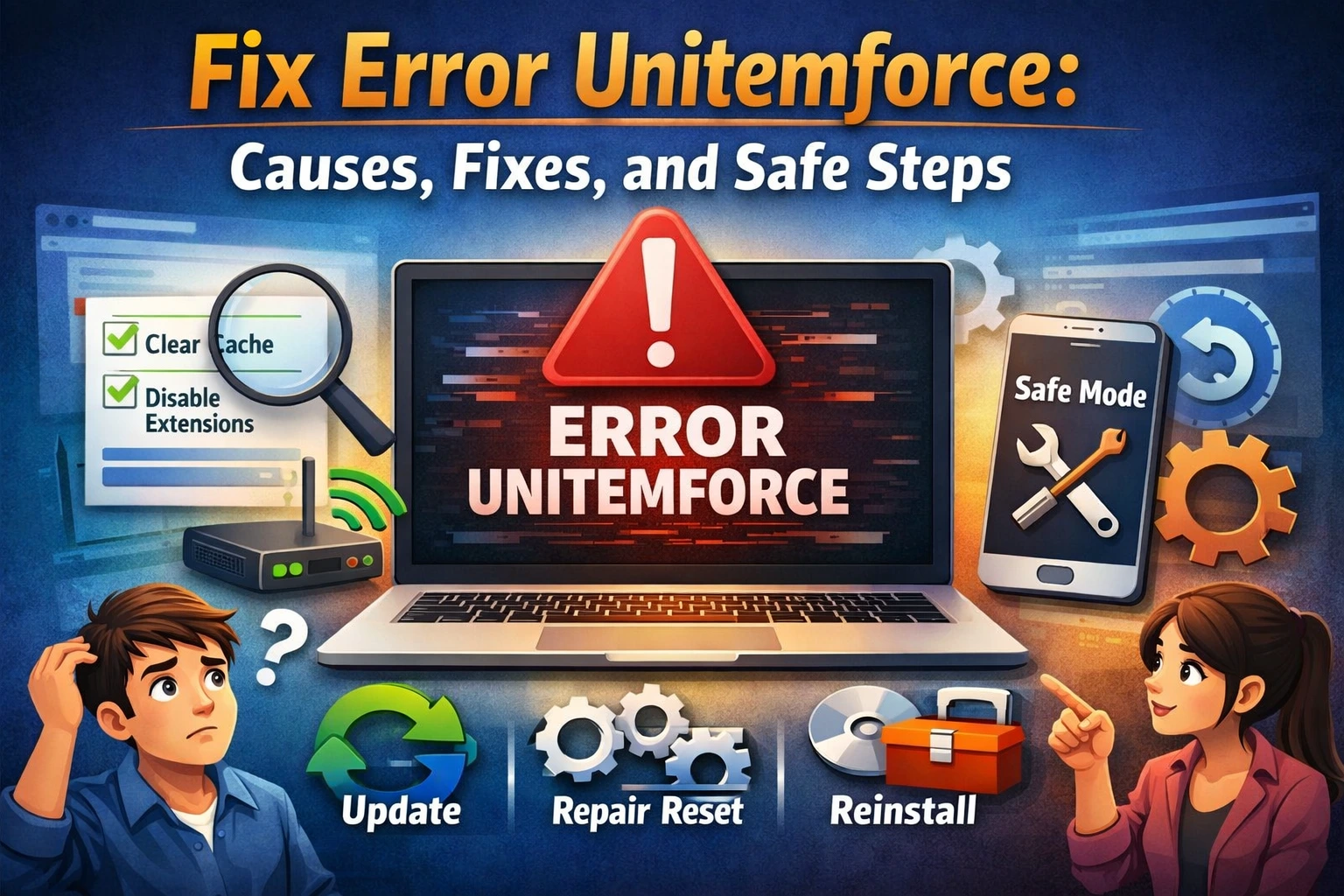
- Confirm the internet connection is working.
- Clear cached browser data or site data.
- Disable extensions or add-ons.
- Update the browser, app, or operating system.
- Test in safe mode or troubleshoot mode.
- Repair, reset, verify, or reinstall only if the issue stays.
Step-by-step: how to fix error unitemforce
1) Check whether the problem is local or service-side
First, see whether the error happens in one app, one browser, or one website only. If everything else works normally, the issue is probably local to that app or browser. If many sites or apps fail at once, the problem may be your network, device, or system settings. This is an inference from the way support teams separate browser/app issues from broader device issues.
2) Clear cache and cookies
Google’s official instructions for Chrome recommend clearing browsing data, including cached images, files, and cookies, when site behavior becomes unstable. This is one of the most common first fixes because old or damaged cached data can keep an error repeating even after the original issue has changed.
3) Disable extensions or add-ons
Mozilla advises using Troubleshoot Mode in Firefox, which temporarily disables add-ons, themes, and hardware acceleration to help identify the cause of a problem. If the error disappears in that mode, one of the disabled items is likely responsible.
This is especially useful for script-like errors. Ad blockers, privacy tools, and browser customizations can interfere with page loading, login scripts, and embedded components.
4) Update the app, browser, or operating system
Microsoft recommends keeping Windows updated when troubleshooting app problems, and its support documentation also points to repair and reset options for apps that are not running correctly. Updates matter because old builds can contain bugs that have already been fixed in newer versions.
5) Test in safe mode on Android
Google’s Android support recommends Safe Mode to help identify whether a third-party app is causing the issue. In Safe Mode, some home-screen widgets and nonessential apps are temporarily disabled, which makes it easier to isolate the source of the problem.
If the error disappears in Safe Mode, the next step is to review recently installed apps, overlays, launchers, or tools that might be interfering. That is usually faster than trying random fixes.
6) Repair or reset the app on Windows
Microsoft’s support documentation for Windows apps recommends using Repair first, then Reset if the problem continues. Repair is the safer option because it tries to fix the installation without removing all app data. Reset is more aggressive and can clear app-specific settings.
7) Reinstall only after the simpler fixes fail
Reinstalling can help when files are damaged, but it should usually come after cache clearing, extension checks, and repair/reset attempts. Microsoft places repair and reset before reinstall in its troubleshooting flow, which is a good sign that reinstalling is not the first move.
8) If it is a launcher or game-style error, verify files
Community troubleshooting for launcher script errors often recommends restarting the launcher, verifying files, or reinstalling when needed. That pattern is common when the error appears inside a game client, launcher, or embedded browser component.
Key features of a good fix
A good fix for an unknown error does not rely on guesswork. It follows a clear process:
- it removes likely causes one at a time;
- it tests after each change;
- it starts with low-risk steps;
- it keeps the original problem visible until the cause is found.
That approach saves time because it helps you identify whether the problem is in the browser, the app, the operating system, or the network. It also prevents the common mistake of changing too many things at once and losing the real cause.
Read more: Fivebpeol: Complete Beginner’s Guide (2026 Update)
Benefits of this troubleshooting method
The biggest benefit is control. Instead of trying random fixes, you move through a clean sequence that is already supported by major platform help pages. That makes it more likely you will find the root cause, not just hide the symptoms.
It is also safer. Clearing cache, disabling add-ons, or testing in Safe Mode is usually less risky than reinstalling everything right away. For many users, that means less downtime and fewer settings lost.
Drawbacks and limits
This troubleshooting approach is not magic. If the problem is actually on the service side, such as a server outage or a broken remote script, local fixes may not solve it. That is an inference, but it follows from the fact that cache clearing, extension disabling, and app repair all target the local environment rather than the remote service.
It also takes patience. Because the method is systematic, you may need to test several steps before the cause becomes obvious. That is normal and usually better than guessing.
Real-world use cases
This kind of error often shows up in situations like these:
- a browser page that will not load properly;
- a launcher or login screen that freezes;
- an app that opens but crashes or blanks out;
- an Android phone that misbehaves because another app is interfering;
- a Windows app that needs repair or reset.
One real-world example from a Reddit thread showed users dealing with a launcher script issue where ad blockers, launcher layout changes, file verification, and reinstall attempts all came up as possible solutions. That is a useful model for thinking about “unitemforce”: treat it as an environment problem until proven otherwise.
Comparison: browser issue vs app issue vs device issue
A browser issue usually improves after clearing cache, cookies, or extensions. A desktop app issue often needs repair, reset, or reinstall. A mobile device issue may need Safe Mode to isolate another app that is causing trouble. Those differences matter because the correct fix depends on where the failure is happening.
In simple terms:
- Browser issue: check cache, cookies, and extensions.
- App issue: repair, reset, update, or reinstall.
- Device issue: test in Safe Mode or use system troubleshooters.
Common mistakes people make
The most common mistake is reinstalling too early. It is tempting, but it can waste time if the real cause is a browser extension or a cached script. Google and Mozilla both place earlier, lighter troubleshooting steps before bigger changes.
Another mistake is changing several things at once. That makes it hard to know what fixed the issue. A better method is to make one change, retest, and then move to the next step only if needed. This is the same logic used in official troubleshooting guides.
A third mistake is ignoring security or filtering tools. In launcher-style errors, ad blockers or similar tools can interfere with scripts and make the issue look like something else entirely.
Expert tips and best practices
Keep a record of the exact place where the error appears. Note the device, app version, browser, and the actions that trigger it. That makes it much easier to isolate the problem later. This is a practical extension of the “change one thing at a time” method used in official troubleshooting flows.
Also, test in the cleanest environment you can. For browsers, that means Troubleshoot Mode or a fresh profile. For Android, that means Safe Mode. For Windows apps, that means Repair or Reset before reinstalling.
If the issue is in a game launcher or a site embedded inside an app, check whether the problem changes after disabling extensions or security tools. That one step can quickly reveal whether the error is truly inside the app or coming from something around it.
Future trends and updates
The trend in modern troubleshooting is moving toward built-in repair tools, better diagnostics, and simplified modes that reduce outside interference. Microsoft offers repair and troubleshooters, Mozilla offers Troubleshoot Mode, and Google offers Safe Mode guidance on Android. That points to a future where users are guided more quickly to the source of the problem instead of being left with a vague error message.
For users, that means one practical shift: the safest fix is no longer “try everything.” It is “isolate the cause first.” That mindset works now, and it will keep working as apps and browsers become more complex.
Conclusion
If you are trying to fix error unitemforce, treat it as an unknown local issue rather than a formal system code. The best path is simple: check the environment, clear cache, disable extensions, update everything, test in Safe Mode or Troubleshoot Mode, and then repair or reinstall only if the problem remains. That is the most reliable, lowest-risk way to narrow down what is actually broken.
FAQs
1) What does “unitemforce” mean?
It does not appear to be a standard official error code. Search results suggest it is usually used as a label for an unclear browser, app, or script problem.
2) What is the first thing I should try?
Start with the easiest fixes: check your connection, then clear cache and cookies, and then disable extensions or add-ons. Those are common first steps in official browser troubleshooting.
3) Can ad blockers cause this type of error?
Yes. Community troubleshooting for launcher-style script errors shows that ad blockers or similar tools can interfere with scripts and trigger error behavior.
4) Should I reinstall the app right away?
No. Microsoft recommends trying repair or reset options before reinstalling apps on Windows. Reinstalling is usually a later step, not the first one.
5) How do I test whether an Android app is causing it?
Use Safe Mode. Google says Safe Mode helps identify problem apps by temporarily disabling some third-party behavior, which makes it easier to isolate the cause.
6) What if the error only happens in Firefox?
Use Firefox Troubleshoot Mode. Mozilla says it disables add-ons, themes, and hardware acceleration so you can see whether one of those is causing the issue.
7) What if none of the fixes work?
Then the issue may be tied to a specific service, a deeper app corruption, or a system-level problem. At that point, update the app or OS, run built-in troubleshooters, and check whether the issue happens in a clean profile or Safe Mode.