



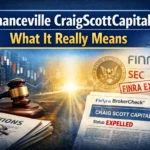






When people search for melanie at craigscottcapital, they are usually trying to answer one of two questions: “Who is Melanie?” and “Is this source trustworthy?” That is the right instinct. The name appears on multiple CraigScottCapital.com pages, but the firm behind the brand also has a public regulatory history that deserves attention before anyone treats the content as authoritative financial guidance.
The safest way to read this topic is to separate the website’s presentation from the firm’s public record. On the site itself, “Melanie Dandell” appears repeatedly as a byline across many articles, while the pages that mention Melanie describe her in broad finance-and-strategy terms. At the same time, FINRA and the SEC have public actions tied to Craig Scott Capital, LLC that raise serious compliance concerns.
What is Melanie at CraigScottCapital?
Melanie at CraigScottCapital appears to be a site-level author or brand persona used across CraigScottCapital.com content, not a clearly documented independent public executive profile. The broader firm, Craig Scott Capital, LLC, was expelled by FINRA in 2017 and is no longer registered as a broker-dealer
Based on the pages reviewed, Melanie at CraigScottCapital is best understood as a name associated with CraigScottCapital.com content. The homepage shows “Melanie Dandell” as the byline on numerous posts, and the firm’s article pages use “Melanie” in the title and body copy as a prominent figure in the site’s finance-themed storytelling.
That matters because the available pages do not read like a standard corporate executive bio, an SEC filing, or a verified adviser profile. Instead, they read like content marketing pages that present Melanie as a recurring author or internal voice for the brand. In other words, the phrase is more useful as a content identity than as a confirmed public-facing professional biography. That is an inference from the site structure, not a formal corporate statement.
How the name appears online
The CraigScottCapital homepage lists many posts across categories such as finance, crypto, business, and lifestyle, and “Melanie Dandell” appears again and again as the byline. The site also includes an “About Us” page and a “Contact the Crew” link, which makes it look like a media-style publishing property rather than a simple one-page profile.
Inside the Melanie-specific pages, the writing presents her as a strategic finance professional who combines market analysis, client focus, and data-driven thinking. The pages describe her as someone who works on investment strategy, analysis, and long-term growth, and they position her as a visible voice within the organization.
At the same time, the broader site is eclectic. The homepage shows topics ranging from finance and brokerage comparisons to crypto, gambling, real estate, and even lifestyle content. That mix does not automatically make the site unreliable, but it does mean readers should be careful about assuming every “about” page reflects a formally verified professional background.
How it works: how readers should interpret the page
The practical way to understand this topic is simple:
- Read the page title and byline carefully.
- Check whether the claim is promotional or documented.
- Compare it with public records.
- Decide how much trust the source deserves.
That process is especially important here because the Melanie pages are written in a highly polished, promotional style, while the firm’s public record includes regulatory enforcement actions. The gap between marketing language and public documentation is exactly where readers can get misled.
A good rule of thumb is this: if a page says someone is a senior analyst, strategist, or trusted expert, look for supporting evidence outside the page. For financial topics, the best support usually comes from regulator records, firm registrations, professional disclosures, or reputable third-party reporting. In this case, FINRA’s BrokerCheck and SEC administrative materials are much stronger evidence than self-published marketing copy.
Key features and components
The CraigScottCapital pages centered on Melanie share a few clear features:
- They use a finance-forward tone.
- They describe Melanie as analytical and client-focused.
- They emphasize strategy, data, and long-term growth.
- They frame the content as educational and high-value.
- They repeat the Melanie name across multiple article pages and bylines.
From an perspective, that repetition is deliberate. It helps build topical association between the name “Melanie” and the CraigScottCapital brand. But from a reader-trust perspective, repetition alone is not proof of expertise. It only shows that the name is being used consistently across the site.
Benefits of understanding the term
There are real benefits to decoding a phrase like melanie at craigscottcapital instead of taking it at face value.
First, it helps you avoid confusing a promotional byline with a verified financial credential. Second, it helps you judge the site more carefully, especially when the subject is investing. Third, it gives you a clearer path to fact-checking if you are reading the page for money-related decisions.
It also helps with search intent. People searching this term are often not looking for a deep biography; they want a quick answer: Who is this, and should I trust it? The best content on this topic should answer that immediately.
Drawbacks and red flags
The biggest drawback is that the public-facing Melanie content is not backed by the kind of documentation readers would expect from a regulated financial professional. The site presents a confident narrative, but the firm itself was expelled by FINRA in 2017, and the SEC previously announced charges tied to failures in customer-information protection and books-and-records compliance.
The FINRA decision says Craig Scott Capital, LLC was expelled for excessive trading of customer accounts, churning, false statements in written responses to FINRA requests, supervisory failures, and telemarketing violations. FINRA also states in BrokerCheck that the firm was expelled in September 2017 and is not currently registered as a broker.
The SEC’s 2016 order adds another important layer. It says the firm used personal email addresses to receive thousands of faxes containing sensitive customer data, did not maintain and preserve those communications as required, and had written supervisory procedures that were not reasonably designed to protect customer information. The SEC’s press release says the firm agreed to pay a $100,000 penalty, with additional penalties for the principals.
Real-world use cases
People typically encounter a term like this in a few situations:
- They found the name in a blog post and want to know whether it is a real person.
- They are checking a finance brand before taking advice seriously.
- They are trying to understand whether a site is a media property, a marketing site, or a regulated firm.
- They are doing due diligence after seeing the name in search results.
For investors, that due diligence step is essential. A finance-themed article can look polished while still being a poor source for advice. If a topic involves brokerage services, account safety, or investment recommendations, the first place to check is the relevant regulator, not the article layout.
Read more: MyHub SLB: A Practical Guide to SLB’s Portal Ecosystem
Comparison: promotional profile vs. public record
A clean comparison makes the issue easier to see.
Promotional profile
The site describes Melanie as a finance professional with strategy, analysis, and client-oriented thinking. The language is polished, confident, and designed to build trust.
Public record
FINRA expelled Craig Scott Capital, LLC in 2017, and the SEC’s 2016 action describes serious compliance failures involving sensitive customer data and recordkeeping. Those are hard, verifiable facts from regulators, and they should carry more weight than marketing copy.
Reader takeaway
When the promotional story and the public record do not line up neatly, the public record wins. That does not mean every page on the site is worthless, but it does mean readers should treat the pages as content first and evidence second.
Common mistakes people make
One common mistake is assuming that a named author on a finance site is automatically a licensed adviser or a registered executive. Another is assuming a polished article means the firm behind it has a clean regulatory history. Both assumptions can be expensive mistakes in financial research.
A second mistake is ignoring the date. Craig Scott Capital’s regulatory issues are not vague rumors; they are documented in 2016 and 2017 public actions. If a newer page talks about the brand as if nothing happened, that is a reason to slow down and verify.
Expert tips and best practices
Here is the most practical way to evaluate a term like this:
- Check the source type. Is it a self-published site, a regulator, or a third-party publication?
- Look for documentation. Do you see licenses, filings, or enforcement records?
- Watch for repeated marketing language. Repetition often signals branding, not proof.
- Compare with public databases. FINRA BrokerCheck and SEC releases are stronger evidence for financial topics.
- Stay skeptical of anonymous or unclear bylines. If the identity is not clearly verified, treat the content as informational, not authoritative.
Future trends and updates
The biggest future trend here is not a product update; it is a trust update. Search engines are getting better at evaluating whether content is helpful, original, and credible. That means sites that rely on thin author personas and broad claims are less likely to stay useful over time. This is an inference based on the direction of search quality expectations, not a quote from the sources.
For users, the practical trend is clearer verification. More people are checking regulators, looking at dates, and asking whether a byline is a real professional identity or just a content label. That is a healthy shift, especially in finance.
Conclusion
Melanie at CraigScottCapital is best understood as a content identity used on CraigScottCapital.com, where the name appears repeatedly across finance-themed pages and bylines. But the surrounding context matters: Craig Scott Capital, LLC was expelled by FINRA in 2017 and had earlier SEC actions tied to compliance and customer-information handling. That is the real story behind the search term.
For readers, the takeaway is simple: read the content, but verify the source. In finance, trust comes from evidence, not just polished wording.
FAQs
1) Who is Melanie at CraigScottCapital?
Melanie appears on CraigScottCapital.com as a recurring author/byline, with pages that describe her in finance and strategy terms. The available pages do not function like a verified corporate biography.
2) Is CraigScottCapital a registered broker today?
No. FINRA’s BrokerCheck says Craig Scott Capital, LLC was expelled from FINRA membership in September 2017 and is not currently registered as a broker.
3) Why does CraigScottCapital have a compliance history?
The SEC announced that the firm failed to adopt adequate safeguards for customer information and did not properly preserve certain business communications. FINRA later expelled the firm for multiple rule violations.
4) Is the Melanie content on the site trustworthy?
It may be useful as a marketing or editorial page, but it should not be treated as standalone proof of regulated financial expertise. Public records carry more weight than self-published promotional copy.
5) What should I check before trusting a finance byline?
Check the author’s credentials, compare the page with regulator databases, and look for independent proof of the claims. For brokerage-related topics, FINRA BrokerCheck and SEC filings are the most useful starting points.
6) Why does this keyword show up in so many search results?
Because CraigScottCapital.com publishes multiple pages that repeat the Melanie name, which helps the term appear across search results. That visibility does not automatically mean the pages are independently verified.
7) What is the safest way to read this topic?
Treat Melanie at CraigScottCapital as a content label first, then verify any financial claims against public records before relying on them. That approach protects you from mistaking marketing language for evidence.