








Financeville CraigScottCapital is an informational search phrase connected with FinanceVille’s finance education content and the historical regulatory record of Craig Scott Capital, LLC, a former U.S. broker-dealer. It should not be treated as the name of a verified active investment platform, brokerage service, trading product, or financial advisor.
The phrase is confusing because it combines two different things. “FinanceVille” appears to refer to a finance content website that publishes educational articles. “Craig Scott Capital” refers to a real brokerage firm that previously operated in the United States and later faced serious regulatory action.
That distinction is important for readers. A finance-related name can sound official, but in regulated markets, branding is not enough. Investors must verify whether a firm is currently registered, whether it has disciplinary history, and whether it is legally allowed to offer brokerage or advisory services.
What is Financeville CraigScottCapital?
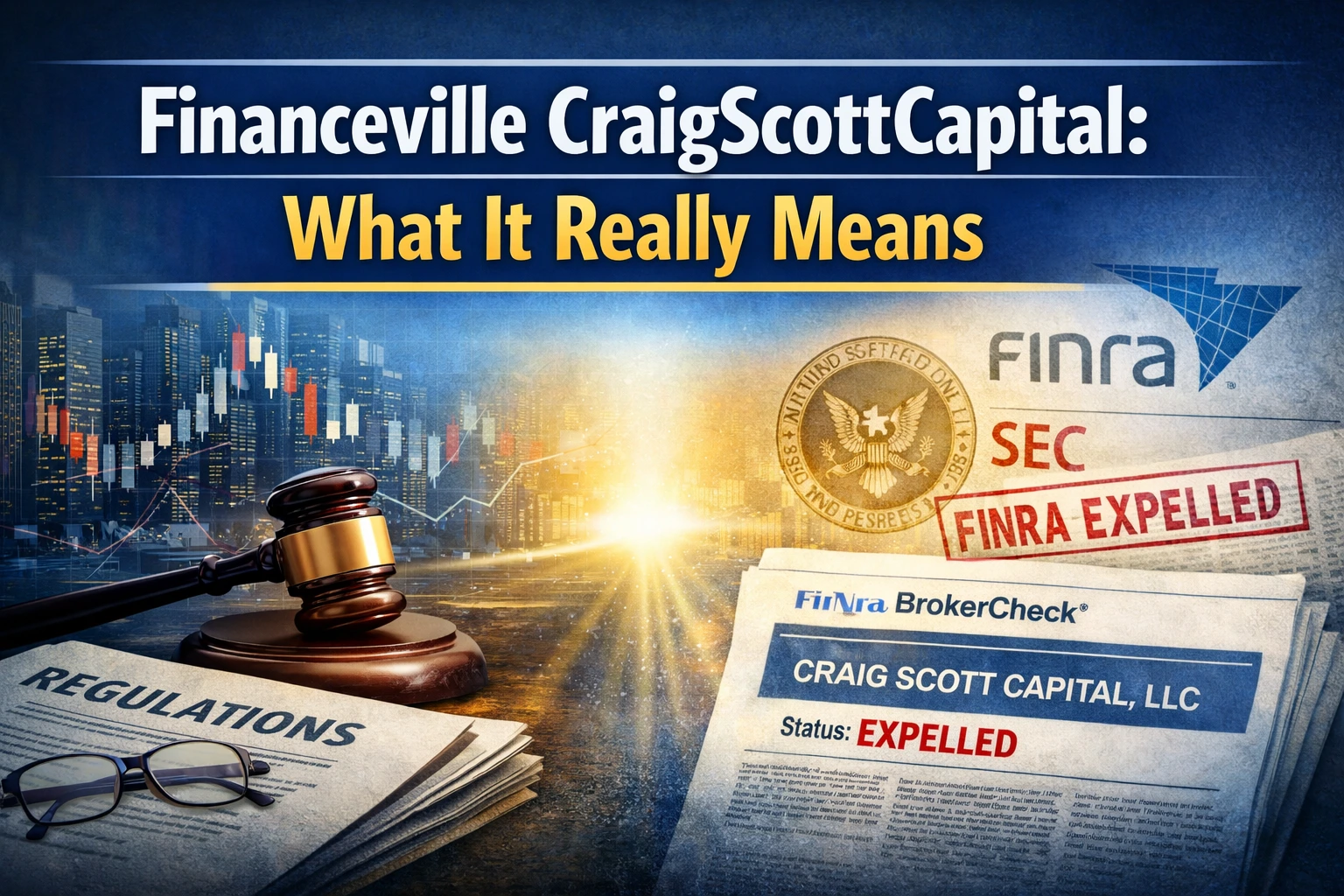
Financeville CraigScottCapital is best understood as an informational keyword about FinanceVille content and the regulatory history of Craig Scott Capital, LLC. Craig Scott Capital was a former broker-dealer that is no longer registered and was expelled from FINRA membership in 2017. FinanceVille appears to be a content-focused finance blog, not a licensed brokerage firm.
Key Takeaways
| Point | Explanation |
|---|---|
| Main keyword | Financeville CraigScottCapital |
| Best meaning | Informational search phrase |
| FinanceVille role | Finance education and content website |
| Craig Scott Capital role | Former U.S. broker-dealer |
| Current broker status | Not currently registered as a broker |
| Main regulatory issue | FINRA expulsion and SEC action |
| Reader caution | Verify any finance name through official regulators |
| Best use of topic | Investor education and due diligence |
What Is Financeville CraigScottCapital?
Financeville CraigScottCapital is not best understood as one single company. It is better understood as a combined search phrase.
The phrase usually appears when people are trying to understand the connection between FinanceVille and Craig Scott Capital. In practical terms, it points to educational content about financial awareness, regulatory history, and investor due diligence.
The “FinanceVille” part refers to a finance content brand or blog-style website. The “Craig Scott Capital” part refers to a former broker-dealer with a documented regulatory history.
This means the keyword should be handled carefully. It is not enough to say it is a finance platform. It is also not accurate to describe it like a modern investment service unless there is current registration proof.
A better definition is:
Financeville CraigScottCapital is an online search phrase used for educational content about Craig Scott Capital’s background, regulatory history, and investor protection lessons.
Why This Keyword Is Confusing
This keyword creates confusion for three reasons.
First, it looks like a brand name. A reader may assume that Financeville CraigScottCapital is one active financial company. That assumption can be misleading.
Second, Craig Scott Capital was a real brokerage firm. Because the name has a real regulatory record, readers need to separate historical facts from modern content pages.
Third, finance websites often publish articles using company names, platform names, or regulatory case names. Those articles may be educational, but readers can mistake them for endorsements or active service pages.
That is why this article uses a verification-first approach. In finance content, accuracy matters more than promotional wording.
What Is FinanceVille?
FinanceVille appears to be a financial information website that publishes content about finance, investing, business, online money topics, digital economy trends, and company-related research.
Based on its public positioning, FinanceVille is closer to a content platform than a regulated financial institution. That means it may help users understand financial concepts, but it should not be treated like a broker, investment adviser, bank, or trading platform.
A content website can be useful when it:
- Explains financial topics clearly
- Summarizes company histories
- Warns readers about risk
- Encourages regulatory verification
- Helps beginners understand complex terms
- Provides educational context
But a content website cannot replace licensed advice. It does not manage investor money, execute trades, custody assets, or provide personalized recommendations unless it is separately licensed to do so.
What Was Craig Scott Capital?
Craig Scott Capital, LLC was a former U.S. broker-dealer. A broker-dealer is a regulated firm that can buy and sell securities for customers or for its own account, depending on its registration and business model.
Like other broker-dealers, Craig Scott Capital was subject to rules involving supervision, suitability, customer protection, records, communications, trading conduct, and regulatory cooperation.
The firm later became known because of enforcement actions involving customer-account trading, supervisory failures, books-and-records issues, customer information protection, and use of personal email accounts for business communications.
The key point is this:
Craig Scott Capital is not a normal current finance brand to evaluate like a new app or fintech platform. It is a historical regulatory case that investors can learn from.
Is Craig Scott Capital Still Active?
No. Craig Scott Capital should not be treated as an active registered brokerage firm.
The important reader takeaway is simple: if a firm is expelled or not currently registered, it cannot be evaluated like an active regulated broker. Any person or website using a similar name should be checked carefully before any money, documents, or personal details are shared.
For investors, this matters because registration status is one of the first trust checks. A firm can have a professional name, a polished article, or an old online footprint, but that does not prove it is authorized to operate today.
The Regulatory History Behind Craig Scott Capital
Craig Scott Capital’s regulatory history has two major parts: SEC action and FINRA action.
SEC Action in 2016
In 2016, the U.S. Securities and Exchange Commission brought a settled administrative proceeding involving Craig Scott Capital, Craig S. Taddonio, and Brent M. Porges.
The SEC case focused on customer information protection, written policies and procedures, personal email use, and required business communication records.
In plain English, the SEC found problems with how the firm handled sensitive customer information and business records. The issues included personal email use for business communications, customer information being routed in ways that were not properly addressed by written procedures, and failures to preserve required communications.
This part of the history matters because financial firms handle sensitive data. Customer names, addresses, Social Security numbers, bank information, brokerage account details, passport copies, and similar records require strong protection.
When a broker-dealer fails to maintain proper safeguards and records, the risk is not only internal compliance failure. It can also create real danger for customers.
FINRA Expulsion in 2017
FINRA later expelled Craig Scott Capital from membership. The FINRA findings involved excessive trading, churning, supervisory failures, do-not-call issues, and false information provided to the regulator.
This is the most serious part of the story for investors.
Excessive trading means an account is traded too frequently in relation to the customer’s profile, objectives, financial situation, and account size. Churning is a more severe form of misconduct where excessive trading is done with an intent to generate commissions or with reckless disregard for the customer’s interests.
In simple terms, the concern is this:
The account may be traded in a way that benefits the broker or firm through commissions, while damaging the customer through costs, losses, and unsuitable activity.
FINRA’s action made the case an important investor-protection example.
Timeline of Key Events
| Year | Event |
| 2012 | Craig Scott Capital’s broker-dealer registration period began |
| 2016 | SEC settled action involving customer information protection and books-and-records issues |
| 2017 | FINRA expulsion became final |
| After 2017 | Firm no longer operated as an active registered broker-dealer |
| 2025–2026 | FinanceVille and other sites discussed the topic as educational content |
This timeline helps readers understand why the keyword is searched today. The topic is not mainly about current services. It is about history, risk, verification, and investor education.
Why FINRA Expulsion Matters
FINRA expulsion is a major disciplinary outcome. It means the firm is removed from FINRA membership and cannot continue operating as a FINRA member broker-dealer.
For investors, this matters because FINRA membership and broker registration are part of the regulatory framework that helps protect customers. These systems create oversight, recordkeeping obligations, dispute mechanisms, and enforcement pathways.
When a firm is expelled, the public should treat that as a serious warning sign.
It does not mean every person ever connected to the firm committed the same conduct. But it does mean the firm’s regulatory history must be understood before any similar name is trusted.
Why SEC Books-and-Records Issues Matter
Books-and-records rules may sound technical, but they are central to financial regulation.
Broker-dealers must preserve business communications and records because regulators need to reconstruct what happened if there is a customer complaint, investigation, suspicious activity, or dispute.
If a firm uses personal email accounts, fails to preserve messages, or does not follow written procedures, it becomes harder to review customer communications and business conduct.
That is why books-and-records violations are not minor paperwork issues. They can weaken accountability.
Why Customer Information Protection Matters
Financial firms often collect highly sensitive customer information. This can include:
- Full names
- Addresses
- Phone numbers
- Social Security numbers
- Bank account details
- Brokerage account numbers
- Driver’s license copies
- Passport copies
- Financial statements
- Tax information
If this information is not handled securely, customers may face privacy, fraud, or identity theft risks.
The Craig Scott Capital SEC action is useful for readers because it shows that financial due diligence should include more than investment performance. A firm’s data protection practices also matter.
Financeville CraigScottCapital as an Educational Topic
The modern relevance of Financeville CraigScottCapital is educational. The topic helps readers understand how to evaluate financial names online.
A reader who sees this phrase should ask:
- Is this an active firm or a historical reference?
- Is FinanceVille offering education or regulated services?
- Is Craig Scott Capital currently registered?
- What do official records say?
- Are there disciplinary actions?
- Is anyone using a similar name to create confusion?
- Should I trust a blog post or check regulators first?
These questions are more useful than simply asking whether the keyword is “good” or “bad.”
Is Financeville CraigScottCapital a Financial Platform?
No, not in the way people usually mean “financial platform.”
A financial platform usually lets users invest, trade, manage accounts, open portfolios, receive advice, or connect money. Financeville CraigScottCapital does not appear to describe that kind of active regulated service.
Instead, the phrase is best interpreted as an article topic or search query. It connects a financial content website with a historical broker-dealer case.
This distinction protects readers from a common mistake: assuming that a finance-sounding phrase equals an active, trustworthy service.
Is FinanceVille a Brokerage Firm?
FinanceVille should not be treated as a brokerage firm unless it provides clear regulatory proof. Based on available public positioning, it appears to be a content-focused blog that publishes financial guides and informational articles.
That means readers can use it for learning, but they should not treat it as a place to open accounts, receive personalized advice, or make investment decisions.
The practical rule is simple:
Educational content can help you understand. Regulatory records help you verify.
Why Searchers Should Be Careful
This topic belongs to the finance category, which means accuracy matters. Inaccurate finance content can cause real harm.
A reader might search Financeville CraigScottCapital because they want to know whether a platform is safe. If an article wrongly describes it as a trusted active financial service, the reader may make poor decisions.
The safer approach is to say exactly what is known:
- FinanceVille is a finance content site.
- Craig Scott Capital was a former broker-dealer.
- Craig Scott Capital is no longer registered as a broker.
- The firm was expelled from FINRA membership.
- SEC and FINRA records are the strongest sources for the regulatory history.
- The combined phrase should be treated as informational, not promotional.
Investor Lessons From Craig Scott Capital
The Craig Scott Capital case offers several important investor lessons.
1. Always Check Broker Registration
Before trusting a broker or investment firm, check whether it is currently registered. Do not rely on a website, name, old article, LinkedIn profile, phone call, or email.
Official databases matter.
2. Read Disclosures Carefully
Disclosures can show regulatory actions, customer complaints, arbitration awards, terminations, and other important history.
A firm with serious disclosures may still be discussed online, but readers should understand the background before trusting it.
3. Watch for Excessive Trading
Excessive trading can drain an account through costs. Even if some trades are profitable, constant commissions and fees can make it difficult for the customer to come out ahead.
Warning signs include:
- Frequent buy and sell recommendations
- Pressure to trade often
- High commissions
- Complex products without clear reason
- Little connection to your goals
- Account value falling while trading continues
- Broker benefits increasing while your account suffers
4. Do Not Ignore Supervision Problems
A brokerage firm is responsible for supervising its representatives. If a firm fails to respond to red flags, customer harm can continue longer.
Supervision is not a background issue. It is part of investor protection.
5. Data Security Matters
A firm that handles financial information must protect customer records. Weak data handling can expose customers to privacy and identity risks.
6. Avoid Name-Based Trust
A professional name does not prove legitimacy. Many risky or inactive entities sound credible.
Verify first.
Active Financial Firm vs Historical Case Study
| Question | Active Financial Firm | Craig Scott Capital Context |
| Currently registered? | Should be yes | No, not currently registered |
| Can open new customer accounts? | If properly licensed | No |
| Has current regulatory oversight? | Yes, if active | Historical record only |
| Main purpose for readers | Service evaluation | Investor education |
| Best source to check | BrokerCheck, SEC, state regulators | BrokerCheck, SEC, FINRA records |
| Risk if misunderstood | Investor confusion | High |
This comparison makes the keyword easier to understand. Financeville CraigScottCapital is not a current service page. It is better treated as a research and education topic.
Read more: What Is Technologies HearthssGaming?
How to Verify a Financial Firm
Use this process before trusting any broker, advisor, or investment company.
Step 1: Search FINRA BrokerCheck
BrokerCheck helps users research brokers and brokerage firms. It can show registration status, disclosures, firm history, and disciplinary information.
Step 2: Search the SEC Database
The SEC provides information about investment advisers, enforcement actions, litigation releases, administrative proceedings, and related records.
Step 3: Check State Regulators
State securities regulators may have additional records, complaints, or registration information.
Step 4: Review the Firm’s Website
Check whether the firm lists legal name, CRD number, SEC number, address, licenses, disclosures, and terms.
Step 5: Compare Names Carefully
Scammers may use names similar to real or former firms. Look for small spelling changes, unusual domains, copied logos, and vague claims.
Step 6: Avoid Pressure
A legitimate financial professional should not pressure you to act immediately, hide information, or bypass verification.
Step 7: Ask for Written Documents
Never rely only on phone calls, chat messages, or social media. Ask for written disclosures and verify them independently.
Red Flags Around Finance-Sounding Names
Be cautious if you see any of these signs:
- No clear registration number
- No named leadership
- No physical office details
- No regulator link
- Guaranteed returns
- Pressure to deposit quickly
- Requests for crypto payments
- Unclear fees
- Fake testimonials
- Poor spelling in official-looking documents
- Claims that verification is unnecessary
- Refusal to provide written disclosures
- Use of a former firm name without explanation
These red flags do not automatically prove fraud, but they justify caution.
Common Misconceptions
Misconception 1: Financeville CraigScottCapital Is One Active Company
The phrase combines a finance content brand and a former broker-dealer name. It should not be assumed to represent one active company.
Misconception 2: Craig Scott Capital Is Still Operating
Craig Scott Capital is not currently registered as a broker. It is better treated as a historical regulatory case.
Misconception 3: A Finance Blog Is the Same as a Financial Advisor
A finance blog can educate readers, but it does not replace licensed financial advice.
Misconception 4: Old Broker Names Are Safe Because They Were Once Registered
Past registration does not equal current authorization. Always check current status.
Misconception 5: Regulatory Violations Are Just Technical Issues
Some violations involve customer harm, supervision failures, excessive costs, privacy risks, or misleading conduct. They should not be dismissed casually.
Benefits of Understanding This Topic
Understanding Financeville CraigScottCapital can help readers:
- Avoid confusing education content with active finance services
- Learn how regulatory records work
- Understand why broker verification matters
- Recognize excessive trading risks
- Identify data protection issues
- Separate branding from legitimacy
- Make safer financial decisions
The topic is useful because it turns a confusing keyword into a practical investor education lesson.
Drawbacks and Limits of the Topic
The main drawback is that the phrase itself is awkward and easy to misunderstand. It looks like a company name but functions more like a search phrase.
Another limitation is that many online summaries may repeat each other without checking official records. In finance content, this is risky. Readers should always prioritize primary sources such as FINRA and SEC records.
Finally, the topic is historical. It can teach important lessons, but it should not be confused with current market analysis or a live investment opportunity.
Best Practices for Readers
Use this topic as a reminder to follow a verification-first process.
- Do not trust names alone.
- Check current registration.
- Read disciplinary history.
- Verify through official databases.
- Be cautious with old firm names.
- Treat blog content as education, not advice.
- Avoid guaranteed-return offers.
- Ask questions before sharing money or documents.
- Keep screenshots and records of communications.
- Consult qualified professionals for important decisions.
These habits apply to every financial product, not only this keyword.
Final Verdict
Financeville CraigScottCapital is best understood as an informational finance keyword, not an active financial service. FinanceVille appears to be a finance education website, while Craig Scott Capital was a former U.S. broker-dealer with serious regulatory history.
The most important facts are straightforward: Craig Scott Capital is not currently registered as a broker, FINRA expelled the firm in 2017, and the SEC previously brought a settled administrative action involving customer information protection and books-and-records issues.
For readers, the main lesson is bigger than one company name. Always verify financial firms through official regulatory sources before trusting them. A polished name, a finance article, or an old brand reference is not enough.
Financeville CraigScottCapital should be treated as a case study in investor awareness, regulatory verification, and financial due diligence.
FAQs
What does Financeville CraigScottCapital mean?
Financeville CraigScottCapital is an informational search phrase connected with FinanceVille content and the historical regulatory record of Craig Scott Capital, LLC.
Is Financeville CraigScottCapital a real company?
It is not best understood as one active company. FinanceVille appears to be a finance content website, while Craig Scott Capital was a former broker-dealer.
Is Craig Scott Capital still active?
No. Craig Scott Capital is not currently registered as a broker and was expelled from FINRA membership in 2017.
Why was Craig Scott Capital expelled?
FINRA expelled the firm after findings involving excessive trading, churning, supervisory failures, do-not-call issues, and false information to FINRA.
Did the SEC take action against Craig Scott Capital?
Yes. The SEC issued a settled administrative order in 2016 involving customer information protection, Regulation S-P, personal email use, and books-and-records issues.
Is FinanceVille a broker or investment advisor?
Based on its public positioning, FinanceVille appears to be a finance content blog, not a licensed broker or investment advisor.
Should I trust Financeville CraigScottCapital as an investment platform?
No. Treat it as an informational topic. Do not treat it as an investment platform without clear regulatory proof.
How can I verify a broker-dealer?
Use FINRA BrokerCheck, SEC records, and state securities regulator databases. Check current registration and disciplinary disclosures.
What is the main investor lesson from this topic?
The main lesson is to verify every financial firm before trusting it. Registration status and disciplinary history matter more than branding.
Why does this keyword appear online?
It appears because finance websites discuss Craig Scott Capital as a regulatory history and investor education topic. The combined keyword likely comes from search behavior and SEO content.