









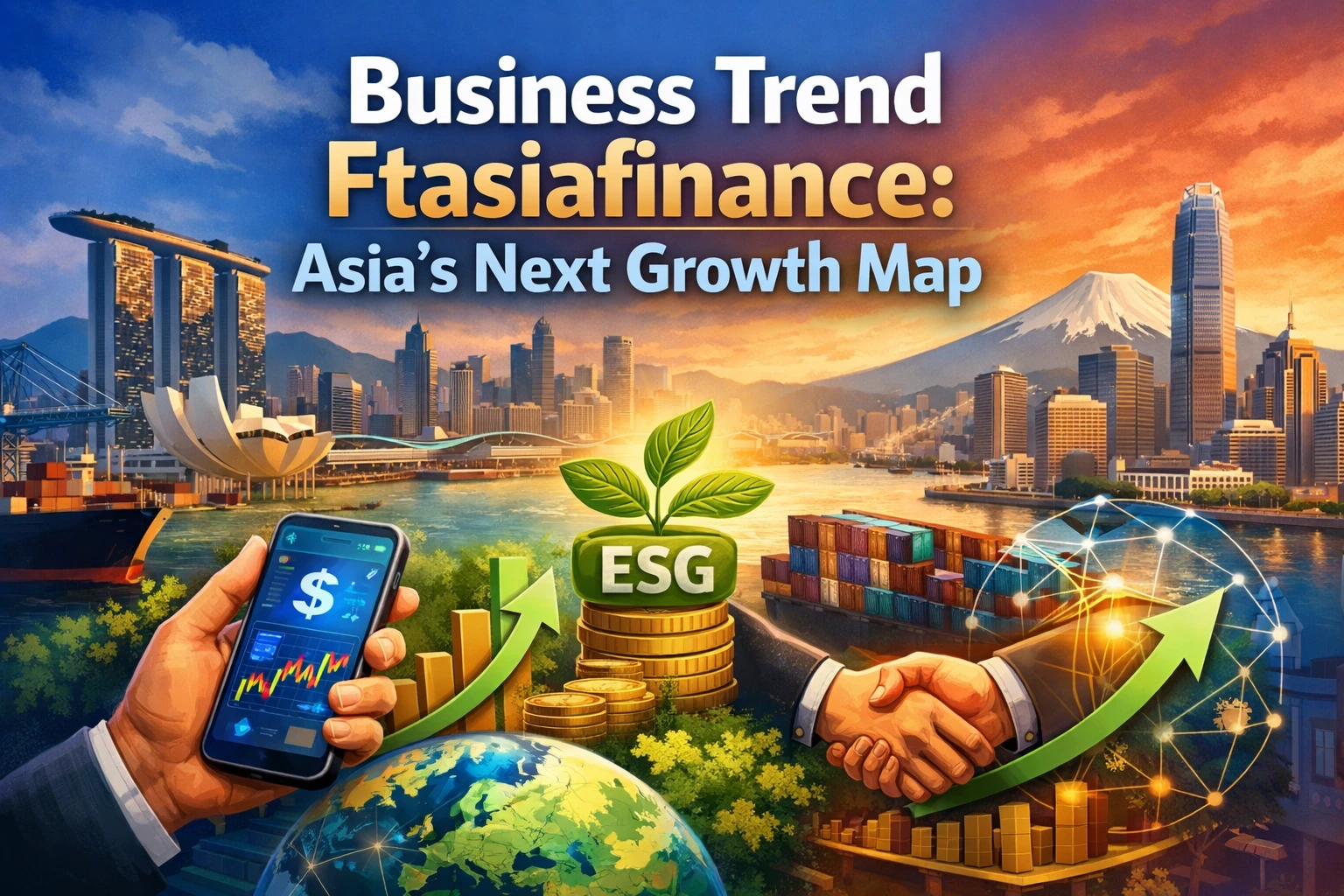
Business trend Ftasiafinance is best understood as a keyword used around Asia-focused business, finance, fintech, market intelligence, and digital transformation. It is not one fixed financial product or official economic index. Instead, the term is used online to describe how businesses can read market signals, understand financial change, and make better decisions in fast-moving Asian markets.
The idea matters because Asia is no longer just a manufacturing base or emerging consumer region. It is now one of the most important centers for fintech, digital payments, embedded finance, AI adoption, supply-chain restructuring, green investment, and regional capital flows. Businesses that understand these shifts early can plan better. Businesses that ignore them often react too late.
In simple words, business trend Ftasiafinance means looking at the direction of business and finance in Asia through practical signals: where money is moving, how customers are changing, which technologies are becoming normal, which regulations are shaping markets, and which risks companies need to manage.
What Is Business Trend Ftasiafinance?
Business trend Ftasiafinance refers to a trend-analysis approach focused on Asian business and finance. It connects several related areas: fintech, banking, digital payments, ESG, open banking, supply-chain finance, AI, investment activity, and regional market growth.
The term is used in different ways across public pages. Some explain it as a business mindset for choosing the right market direction. Others use it for deeper financial analysis across Asia. The strongest interpretation is this:
Business trend Ftasiafinance is a practical lens for understanding the business and financial shifts shaping Asian markets.
That makes the keyword broader than fintech alone. Fintech is a major part of it, but the full topic also includes business planning, capital access, consumer behavior, digital infrastructure, investment trends, and operational risk.
Why This Keyword Matters Now
The business world is changing quickly, especially across Asia. Companies are dealing with new customer habits, digital-first payments, AI tools, changing supply chains, ESG pressure, and tighter financial discipline. At the same time, investors are becoming more selective. They are not only looking for growth; they also want profitability, compliance, resilience, and proof of long-term value.
That is why this topic has stronger search value now. Readers do not only want a definition. They want to know what trends matter, how those trends affect real businesses, and how to apply them.
A useful article should answer three questions:
- What does the term mean?
- Which business and finance trends are shaping Asia?
- How can startups, SMEs, investors, and financial institutions use these trends?
This guide covers all three.
How the Ftasiafinance Trend Lens Works
The approach works by turning market noise into useful business insight.
1. Track Real Signals
A real trend is not just a headline. It shows up in customer behavior, funding flows, regulation, technology adoption, hiring patterns, supply-chain movement, and business margins.
For example, if more users are choosing wallet payments, buy-now-pay-later options, and app-based investing, that is not just a tech story. It is a consumer behavior shift.
2. Group Signals Into Themes
Single events can be misleading. A stronger approach groups signals into themes such as embedded finance, AI in banking, digital wallets, green finance, open banking, regional IPO activity, and supply-chain diversification.
This helps businesses see whether a change is temporary or structural.
3. Translate Trends Into Decisions
Trend analysis becomes valuable only when it supports action. A business may change pricing, launch a digital channel, partner with a fintech company, improve payment options, enter a new market, or reduce supplier risk.
Without decisions, trend content becomes theory.
4. Add Risk Controls
Not every trend is worth chasing. A good business trend framework checks regulation, profitability, customer trust, fraud risk, cash flow, and execution difficulty.
This is especially important in Asia because the region is not one single market. Singapore, Hong Kong, India, Indonesia, Vietnam, Japan, Malaysia, and the Philippines all have different regulations, consumer habits, infrastructure levels, and financial systems.
Key Business Trends Connected With Ftasiafinance
1. Embedded Finance Is Becoming Normal
Embedded finance means financial services are placed inside non-financial platforms. Instead of visiting a bank, users access loans, insurance, payments, wallets, or investments inside apps they already use.
Examples include:
- Pay-later options at checkout
- Insurance inside ride-hailing apps
- Wallets inside e-commerce platforms
- Lending tools inside seller dashboards
- Investment features inside consumer apps
- Payment solutions inside business software
This trend matters because convenience changes behavior. Customers do not want extra steps. They want finance to appear where the need already exists.
For businesses, embedded finance creates new revenue opportunities. A marketplace can offer seller loans. A travel app can offer insurance. A SaaS platform can offer payments. A logistics platform can offer working-capital tools.
The strategic lesson is simple: finance is moving closer to the point of need.
2. Fintech Is Moving From Hype to Profitability
A few years ago, many fintech companies focused mostly on user growth. The market rewarded fast expansion, even when business models were not profitable. That phase is changing.
The newer trend is more disciplined. Investors now want stronger margins, lower acquisition costs, better compliance, and clear revenue models. Fintech is still growing, but the winners are more likely to be companies with real unit economics.
This matters for startups and financial brands. A digital app alone is not enough. The product must solve a real problem, earn trust, manage risk, and make money sustainably.
3. AI Is Becoming a Financial Infrastructure Tool
AI is no longer only a marketing topic. In finance, it is being used for fraud detection, customer support, credit scoring, onboarding, compliance monitoring, risk assessment, personalization, and document processing.
For businesses, AI can reduce manual work and improve decision speed. For banks and fintechs, it can make services more personalized and efficient. For customers, it can create faster support and more relevant financial recommendations.
But AI also creates risks. Poor data, biased models, weak governance, cybersecurity threats, and over-automation can damage trust. That means AI adoption must be controlled, audited, and connected to real business outcomes.
The strongest companies will not be the ones that simply “use AI.” They will be the ones that use AI responsibly to improve speed, accuracy, compliance, and customer experience.
4. Open Banking and Open Finance Are Expanding
Open banking allows approved third parties to access financial data with user consent. Open finance expands the idea beyond bank accounts into broader financial products and services.
In Asia-Pacific, open banking and open finance are developing at different speeds across different markets. Some economies have more formal frameworks. Others are still building the infrastructure.
The business impact is important. Open banking can support better lending, easier account aggregation, more personalized products, and smoother financial comparison tools. For SMEs, it can help lenders assess cash flow more accurately. For consumers, it can reduce friction when switching or comparing services.
However, open banking depends on trust. Data protection, consent, security, and regulation are central. Without those, adoption can slow down.
5. Digital Payments and Super Apps Continue to Shape Asia
Asia has been one of the strongest regions for digital payments and super-app ecosystems. In many markets, users already expect payments, shopping, messaging, mobility, food delivery, and financial tools to work inside connected digital platforms.
This trend changes how businesses compete. A company may not win only because it has the best standalone website. It may win because it connects smoothly with wallets, apps, marketplaces, and payment rails that customers already use.
For small businesses, this means payment convenience is no longer optional. Customers expect fast, mobile-friendly, trusted payment methods.
For large businesses, the opportunity is bigger: build ecosystems, partner with platforms, and create services that fit naturally into daily digital behavior.
6. ESG Is Becoming a Business Requirement
ESG stands for environmental, social, and governance factors. In the past, many companies treated ESG as branding. Now it is becoming more connected to funding, regulation, export readiness, investor trust, and supply-chain access.
This is especially relevant for Asian businesses connected to global trade. Buyers, lenders, and investors increasingly ask for proof: emissions data, ethical sourcing, governance policies, supplier transparency, and climate-related reporting.
The key point is that ESG is no longer only about reputation. It can affect whether a company wins contracts, raises capital, enters export markets, or qualifies for certain partnerships.
But there is also a risk: greenwashing. Businesses that make sustainability claims without evidence can lose trust. The better approach is measurable ESG: real data, clear reporting, and practical improvements.
7. Supply-Chain Finance Is Becoming More Strategic
Supply chains across Asia are changing due to geopolitics, cost pressure, tariffs, climate risk, and diversification away from overdependence on one country or supplier base.
Many companies are exploring China+1 or multi-country sourcing strategies. That can reduce risk, but it also creates financing pressure. Moving suppliers, opening new production lines, changing logistics routes, and holding more inventory all require working capital.
This is where supply-chain finance becomes important. Businesses need better cash-flow planning, trade finance, invoice financing, and supplier payment solutions.
The practical lesson is clear: supply-chain strategy is also a finance strategy.
8. Hong Kong and Singapore Remain Important Financial Hubs
Hong Kong and Singapore continue to matter because they connect capital, regulation, talent, banks, investors, and regional operations.
Hong Kong remains important for IPOs, China-related capital flows, wealth management, and cross-border finance. Singapore remains strong in fintech, private banking, regional headquarters, digital assets regulation, and Southeast Asian market access.
For companies expanding in Asia, these hubs are often more than office locations. They can influence fundraising, partnerships, treasury operations, hiring, and investor credibility.
9. Financial Inclusion Remains a Major Growth Driver
Millions of people and small businesses across Asia still need better access to financial services. Digital wallets, mobile banking, alternative lending, embedded finance, and low-cost payment tools can help close that gap.
Financial inclusion is not only a social issue. It is also a business opportunity. Underserved customers need payments, savings, credit, insurance, remittances, and business tools.
Companies that serve these users responsibly can build large markets. But the key word is responsibly. Inclusion should not become predatory lending or hidden fees. Trust and transparency are essential.
10. Investors Are Becoming More Selective
Asia still offers growth, but investors are not blindly funding every digital idea. They are looking for stronger fundamentals.
Important investor questions include:
- Is the business profitable or moving toward profitability?
- Is customer acquisition cost under control?
- Is there regulatory risk?
- Does the company have strong retention?
- Is revenue recurring or one-time?
- Can the model scale across markets?
- Does the company have a defensible advantage?
- Is the ESG story real or only branding?
This selectivity is healthy. It pushes businesses to build better models instead of chasing short-term hype.
Business Trend Ftasiafinance for Different Audiences
For Startups
Startups can use this trend lens to choose better markets and business models. Instead of launching another generic app, founders should ask where financial friction exists.
Good startup opportunities may include:
- SME lending tools
- Embedded payment solutions
- Invoice financing platforms
- AI compliance software
- Wealth tools for younger investors
- Cross-border payment services
- Insurance inside digital platforms
- ESG reporting tools
- Cash-flow management apps
The key is to solve a real problem, not just follow a buzzword.
For SMEs
Small and mid-sized businesses can use these trends to improve daily operations. The most useful areas are payments, cash flow, digital sales, financing, and supplier management.
An SME should ask:
- Are customers asking for easier payment options?
- Is cash flow being tracked weekly?
- Are suppliers creating working-capital pressure?
- Could digital tools reduce admin work?
- Is the business too dependent on one market or supplier?
- Are ESG or compliance requirements affecting contracts?
For SMEs, the biggest value is not theory. It is practical control.
For Investors
Investors can use the framework to identify sectors where technology, regulation, customer behavior, and capital flows are moving together.
Interesting areas include:
- Embedded finance
- Digital payments
- AI-powered financial infrastructure
- Open banking tools
- RegTech
- WealthTech
- Supply-chain finance
- Green finance
- SME finance
- Cybersecurity for financial platforms
A good investor should avoid chasing trend labels alone. The better question is whether the company has strong economics, real demand, compliance readiness, and market timing.
For Banks
Banks can use the same signals to decide whether to build, buy, partner, or specialize.
In many Asian markets, banks still have trust, deposits, licenses, and customer relationships. But fintechs and platforms often move faster in user experience. The winning model may not always be direct competition. In many cases, partnership makes more sense.
Banks should focus on:
- Better mobile experiences
- Faster onboarding
- Embedded partnerships
- AI-supported operations
- SME finance
- Fraud prevention
- Wealth advisory
- Open banking readiness
- Data-driven personalization
The future bank is not only a branch or app. It is a trusted financial layer connected to customer life and business activity.
For Content Publishers and Analysts
Publishers writing about this keyword should avoid generic business advice. The SERP already has enough thin content. A better article should connect the keyword to real trends, credible data, clear use cases, and practical decisions.
A strong article should include:
- Definition
- Current Asia market context
- Fintech trends
- ESG and sustainability angle
- Digital banking and open finance
- Supply-chain finance
- Benefits and risks
- Examples for startups, SMEs, banks, and investors
- FAQs
- Updated references
That structure satisfies more search intent and improves topical depth.
Read more: Buy ZO35-G25DA74 Model: Complete Expert Guide
Benefits of Following Business Trends
Better Decision-Making
Trend awareness helps businesses avoid guesswork. Instead of launching products based only on personal preference, companies can follow customer demand, market data, and financial signals.
Early Opportunity Detection
Businesses that read shifts early can enter growing markets before competition becomes too intense. This applies to fintech, green finance, digital payments, AI tools, and SME services.
Stronger Risk Management
Trends are not only about growth. They also reveal risk. Regulation, currency pressure, supply-chain disruption, fraud, funding cost, and customer trust can all affect business performance.
More Relevant Products
When businesses understand how customers are changing, they can design better products. For example, digital-first users may prefer app-based onboarding, instant payments, transparent fees, and personalized alerts.
Improved Capital Planning
Understanding market trends helps companies decide when to raise funds, conserve cash, enter a new market, or delay expansion.
Drawbacks and Risks
Trend Content Can Become Vague
Many articles use terms like innovation, transformation, fintech, and growth without explaining what they mean in practice. That weakens usefulness.
Asia Is Not One Market
A strategy that works in Singapore may not work in Indonesia. A product that succeeds in India may need major changes before entering Japan or Hong Kong. Local regulation, language, trust, income level, and infrastructure matter.
Hype Can Hide Weak Economics
Some companies look modern but have poor margins, high customer acquisition costs, weak retention, or unclear compliance. A trend is useful only when the business model works.
Regulation Can Change Quickly
Fintech, crypto, lending, payments, data privacy, ESG reporting, and AI governance are all sensitive areas. Businesses must track rules carefully.
Digital Trust Is Fragile
Fraud, data breaches, hidden fees, and poor customer support can damage a financial brand quickly. Trust is a core asset in finance.
Traditional Trend Analysis vs Ftasiafinance-Style Analysis
| Area | Traditional Trend Analysis | Ftasiafinance-Style Analysis |
|---|---|---|
| Focus | General headlines | Business and finance signals |
| Market view | Often broad | Asia-focused and practical |
| Timeframe | What happened | What it means next |
| Usefulness | Informational | Decision-oriented |
| Finance view | Separate from operations | Connected to customers, cash flow, and risk |
| Technology view | Buzzword-heavy | Linked to adoption, regulation, and profitability |
| Best use | Reading news | Planning business action |
The main difference is action. A stronger trend framework does not only describe change. It helps businesses decide what to do.
Common Mistakes
Treating Asia as One Market
This is the biggest mistake. Asia includes mature financial hubs, fast-growing digital economies, manufacturing centers, export-driven economies, and large consumer markets. Each one behaves differently.
Assuming Every Fintech Trend Is Profitable
Digital adoption does not automatically mean profit. A fintech company still needs margins, retention, trust, compliance, and funding discipline.
Confusing ESG Claims With ESG Proof
Investors and partners increasingly want evidence, not slogans. Companies need measurable reporting and real operational changes.
Ignoring Working Capital
Growth can create cash-flow pressure. More sales, new suppliers, bigger inventory, and cross-border operations can all require more financing.
Copying Competitors Blindly
Following a trend does not mean copying another company. The right move depends on your market, audience, budget, compliance position, and execution ability.
Best Practices for Businesses
Track Fewer Trends More Deeply
Do not try to follow everything. Choose the trends that directly affect your customers, costs, revenue, or risk.
Use Metrics
Track real numbers such as:
- Revenue growth
- Gross margin
- Customer acquisition cost
- Retention
- Payment success rate
- Average order value
- Cash conversion cycle
- Funding cost
- Default rate
- Compliance incidents
Metrics separate real trends from opinions.
Test Before Scaling
A trend may be real, but your product may still need testing. Start with pilots, limited launches, or controlled partnerships before full expansion.
Build Compliance Early
Compliance should not be added at the end. In finance, payments, lending, ESG, AI, and data, compliance is part of the product.
Localize Strategy
Each Asian market needs local understanding. Payment habits, customer trust, language, pricing, and regulation can change the result.
Protect Trust
Trust is difficult to build and easy to lose. Be clear about fees, data use, risk, returns, and customer support.
Future Outlook
The future of business trend Ftasiafinance will likely be shaped by five forces.
First, fintech will continue moving toward mature business models. The market will reward companies that combine growth with profitability.
Second, AI will become more deeply embedded in banking, payments, compliance, fraud detection, and customer service.
Third, embedded finance will keep expanding because customers prefer financial tools inside platforms they already use.
Fourth, ESG and supply-chain transparency will become harder to ignore. Companies connected to global trade will need better reporting and supplier visibility.
Fifth, Asian financial hubs will remain important. Hong Kong, Singapore, Tokyo, Shanghai, Mumbai, Seoul, and other major centers will continue influencing capital flows, IPOs, wealth management, and innovation.
The strongest businesses will not chase every trend. They will choose the trends that match their market, capabilities, and customer needs.
Conclusion
Business trend Ftasiafinance is not just a keyword about business success. It is a useful way to understand how Asian business and finance are changing through fintech, embedded finance, AI, ESG, digital payments, open banking, supply-chain finance, and regional investment activity.
The real value is practical. Founders can use it to find better opportunities. SMEs can use it to improve cash flow and digital operations. Investors can use it to identify stronger sectors. Banks can use it to modernize products and partnerships.
The safest takeaway is simple: follow signals, not hype. Asia offers major business opportunities, but success depends on local understanding, financial discipline, customer trust, and smart execution.
FAQs
What does business trend Ftasiafinance mean?
Business trend Ftasiafinance refers to an Asia-focused way of understanding business, finance, fintech, digital transformation, investment activity, and market changes.
Is business trend Ftasiafinance a company?
The term is used online around finance and business-trend content. It is better understood as a keyword or trend-analysis angle rather than a single fixed financial product.
Is it only about fintech?
No. Fintech is a major part of the topic, but it also includes ESG, digital banking, AI, open finance, supply-chain finance, investment trends, and regional business strategy.
Why is Asia important in this topic?
Asia has fast-growing digital economies, large consumer markets, strong fintech adoption, major manufacturing networks, and important financial hubs such as Singapore and Hong Kong.
What is embedded finance?
Embedded finance means offering financial services inside non-financial platforms, such as loans at checkout, insurance in travel apps, or payments inside business software.
How can small businesses use this trend?
Small businesses can use it to improve payment options, manage cash flow, track customer demand, reduce supplier risk, and choose better financing tools.
Why is ESG part of business trend Ftasiafinance?
ESG is becoming more important for funding, regulation, supplier selection, export readiness, and investor trust. Businesses increasingly need measurable sustainability and governance practices.
What is the biggest risk in following business trends?
The biggest risk is chasing hype without checking profitability, regulation, customer demand, cash flow, and execution ability.
How can investors use this framework?
Investors can use it to identify sectors where technology, regulation, customer behavior, and capital flows are moving together, such as fintech infrastructure, embedded finance, RegTech, AI finance tools, and green finance.
What is the future of business trend Ftasiafinance?
The future is likely tied to AI-driven finance, embedded platforms, open banking, ESG reporting, supply-chain finance, and stronger regional capital flows across Asia.